AI Deep Research 2: Compliance & Private Labeling
Regulatory Compliance and Operational Risk Assessment: Rebranding BESS Technologies in the North American Market
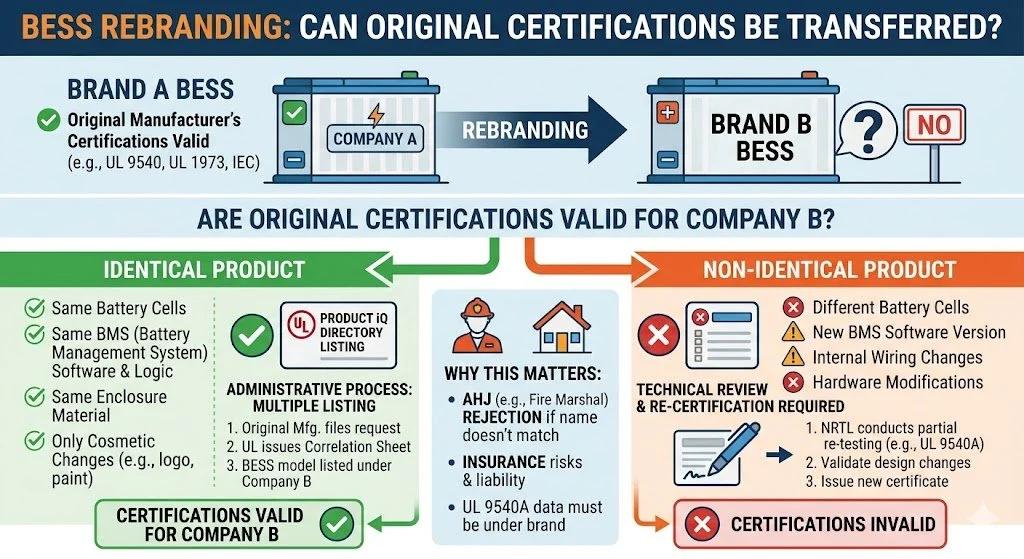
The global energy transition has established Battery Energy Storage Systems (BESS) as the primary mechanism for grid stabilization and renewable energy firming. As the market experiences a compound annual growth rate of 20.1% from 2023 to 2035, the commercial landscape is increasingly defined by complex original equipment manufacturer (OEM) and rebranding arrangements. A prominent example is the strategic maneuver where Wanbang Digital Energy, operating under the Star Charge brand, rebrands BESS units manufactured and certified by REPT BATTERO Energy Co. Ltd.. While this strategy allows for rapid market penetration and leverages established sales infrastructure, it introduces substantial regulatory and legal risks. The core of this assessment addresses whether the safety certifications held by REPT BATTERO—specifically UL 1973, UL 9540, and UL 9540A—remain valid when the hardware is marketed under the Star Charge brand. The short answer in the professional compliance landscape is that these certifications are not automatically valid for the rebranded entity without formal administrative bridging through a Nationally Recognized Testing Laboratory (NRTL).
The Technical and Commercial Profile of the Principals
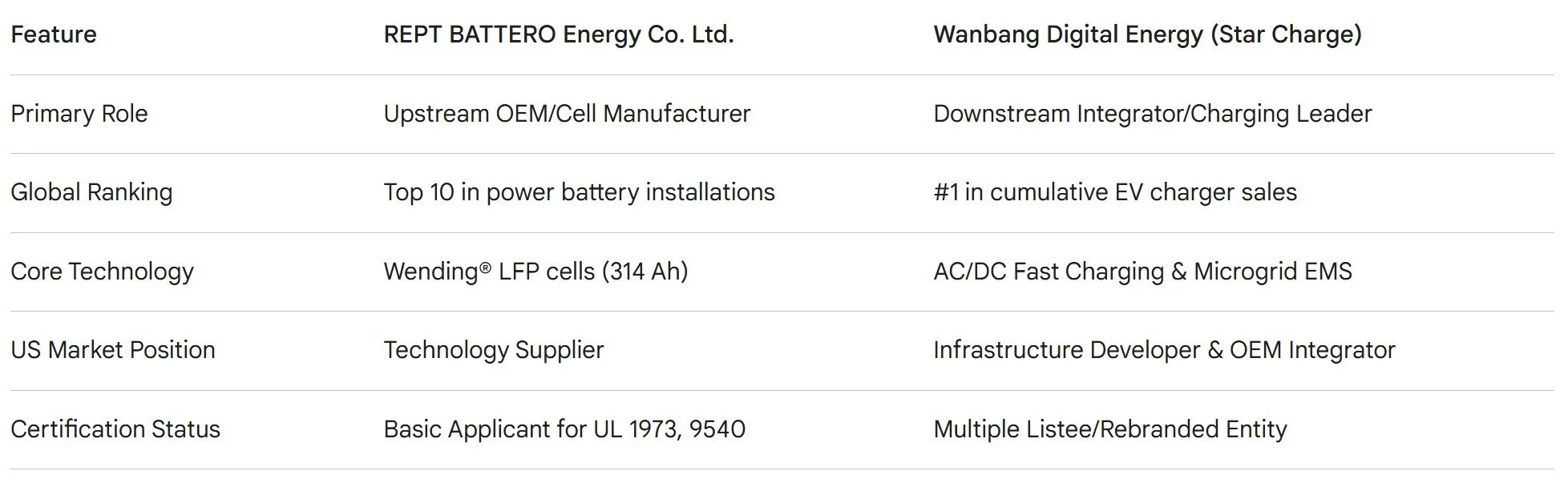
To assess the risks of rebranding, one must first evaluate the technical depth of the base manufacturer and the commercial reach of the rebranding listee. REPT BATTERO, established in 2017 and backed by the Fortune Global 500 Tsingshan Holding Group, has rapidly ascended to a leadership position in the electrochemical storage sector. The company’s competitive advantage stems from its vertical integration within the Tsingshan Group, which controls significant portions of the global nickel and lithium supply chains. REPT’s technical core is defined by its Wending® technology, which optimizes cell internal space and ionic conductivity, and its flagship 314 Ah battery cells. As of late 2022, the company held over a hundred domestic and international certifications, including extensive listings for stationary energy storage.
Star Charge Americas, the rebranding entity, is the North American arm of Wanbang Digital Energy, recognized as the world’s number one EV charging equipment provider by cumulative sales volume. Since launching its North American operations in 2021, Star Charge has established a robust presence with its headquarters in Fremont, California, and manufacturing facilities in Columbus, Ohio. The company has signed a multibillion-dollar Master Service Agreement (MSA) with Beneficial Holdings, Inc. to deploy over 32.24 GWh of BESS projects across the United States and Puerto Rico, specifically targeting the burgeoning data center industry.
Principal Comparison: REPT BATTERO vs. Star Charge
The Legal and Regulatory Mechanism of Multiple Listing
The validity of safety certifications in a rebranding scenario is governed by the UL "Multiple Listing" service. In the North American regulatory framework, a safety certification is an agreement between the NRTL and a specific legal entity (the Basic Applicant) for a specific set of model numbers manufactured under a verified quality management system. When Star Charge places its name on a REPT BESS, the original REPT test reports and certificates do not inherently cover the Star Charge name or model numbers.
The Requirement for an Administrative Bridge
For the certifications to be valid for the rebranded BESS, Star Charge must formalize its status as a "Multiple Listee" through UL Solutions or a similar NRTL. This process involves a formal request to have the Multiple Listee’s name, file number, tradename, and unique product designation appear on a product that is already certified for the Basic Applicant (REPT).
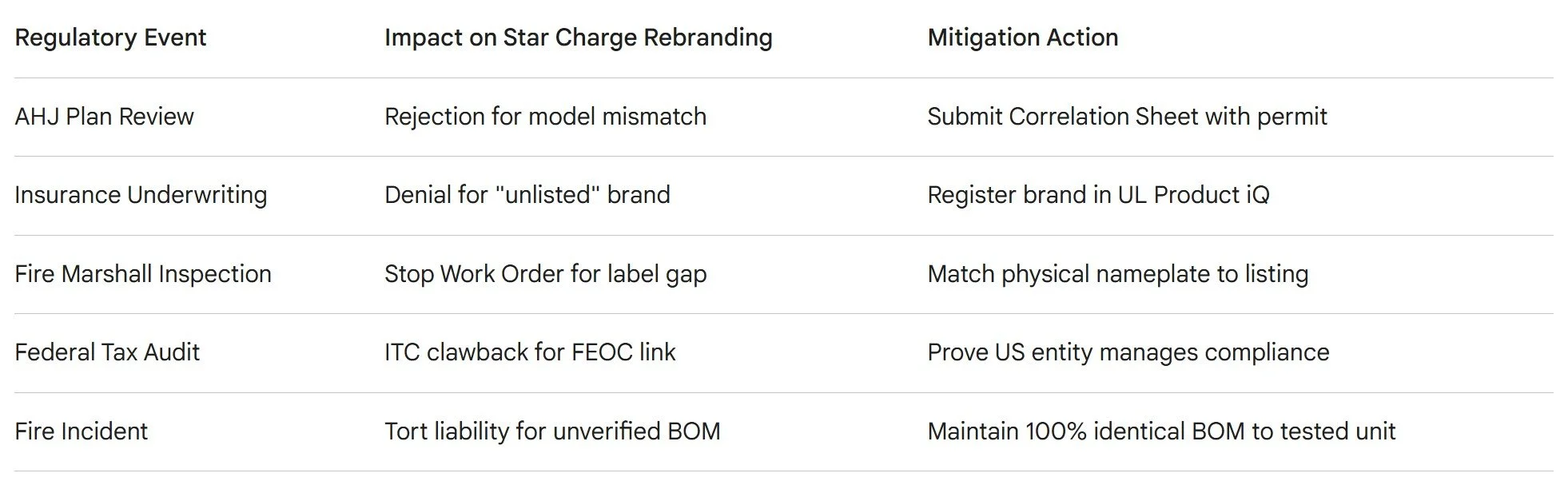
This administrative bridging is non-negotiable for project bankability and insurance. A "Multiple Listing Correlation Sheet" is generated, which explicitly links the REPT-certified models to the Star Charge-branded models. Without this document, an electrical inspector or Fire Marshal—referred to as the Authority Having Jurisdiction (AHJ)—is likely to reject the installation upon finding a brand or model number that is not listed in the official UL Product iQ directory.
Restrictions on Physical Modifications
The validity of the transferred certification remains contingent on the product being identical to the original certified sample. Under the terms of the Multiple Listing program, the product for which the listing is requested must not differ from the "Basic Product" other than in superficial features, such as color, trim, and brand identification. If Star Charge makes structural changes to the enclosure, modifies the internal air handling units (AHU), or updates the cooling system, the original REPT 9540A fire test results and UL 9540 system listing may be rendered invalid.
Technical Nuances of BESS Safety Standards
The risk assessment must account for three distinct tiers of safety documentation: module-level safety, system-level integration, and performance-based fire behavior.
UL 1973: The Battery Safety Foundation
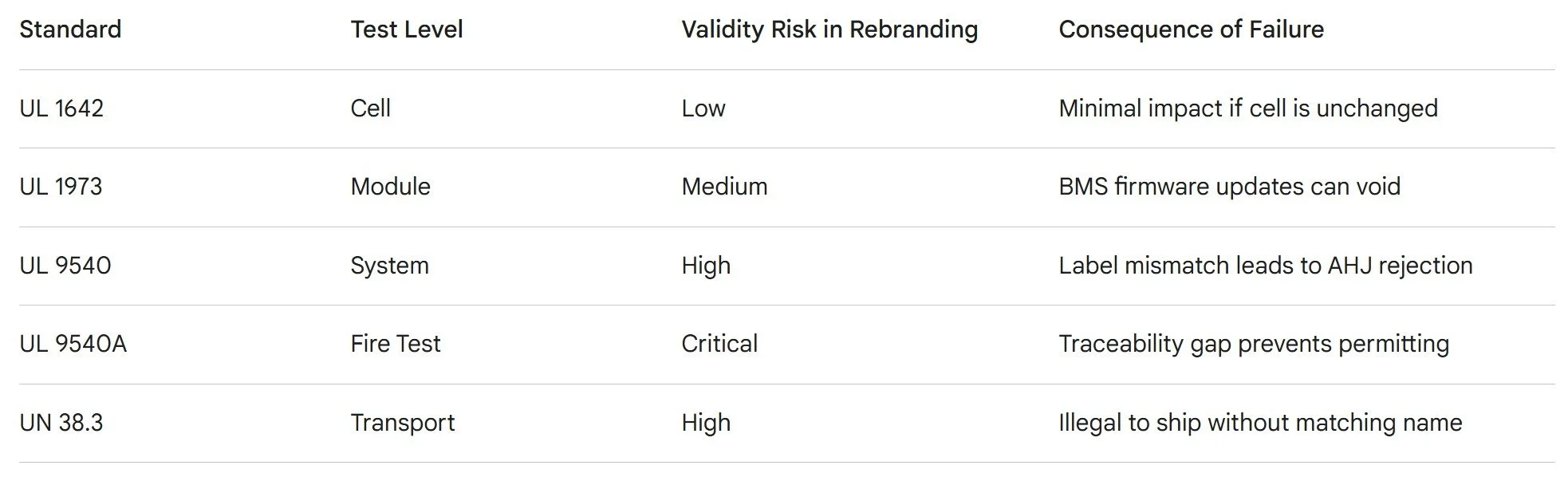
UL 1973 (Standard for Batteries for Use in Stationary and Motive Auxiliary Power Applications) evaluates the electrochemical safety of the modules. For REPT, achieving this certification involves rigorous abuse testing, including overcharge, forced discharge, and short-circuit evaluations. A critical element is the validation of the Battery Management System (BMS) to ensure it can effectively prevent over-temperature and cell imbalance conditions. If Star Charge rebrands these modules, it must ensure that the BMS software version remains consistent with the listed version, as any logic change could necessitate a re-evaluation of the UL 1973 compliance.
UL 9540: Comprehensive System Listing
UL 9540 is the overarching safety standard that treats the battery, inverter, and control software as a single integrated product. For the Star Charge eBox or vBox units, this listing proves that the REPT battery modules and the chosen power conversion system (PCS) are compatible and safe under both normal and fault conditions.
The third edition of UL 9540, which went into effect in late 2024, introduces more stringent requirements for explosion control and noise levels. If a project in 2026 relies on an older REPT listing that has not been updated to the current edition, the rebranded product may fail to meet contemporary local fire codes. This is particularly critical for data center applications where high energy density and indoor installation are common.
UL 9540A: Fire Propagation Data Traceability
The most complex area of rebranding risk is UL 9540A, which is not a pass/fail certification but a data-generating test method. The 6th Edition of UL 9540A (March 2026) places massive emphasis on unit-level and installation-level fire behavior.
Project developers use REPT’s 9540A test reports to justify separation distances to the AHJ. If the Star Charge-branded unit has even a minor deviation in the enclosure material, venting strategy, or fire suppression agent from the sample REPT tested in the lab, the AHJ may deem the 9540A report inapplicable. The 2026 edition of NFPA 855 explicitly requires "data traceability"—the ability to prove that the tested configuration exactly matches the installed equipment.
Comparative Risk Matrix for Rebranded Certification Levels
Regulatory Enforcement and The Role of the AHJ
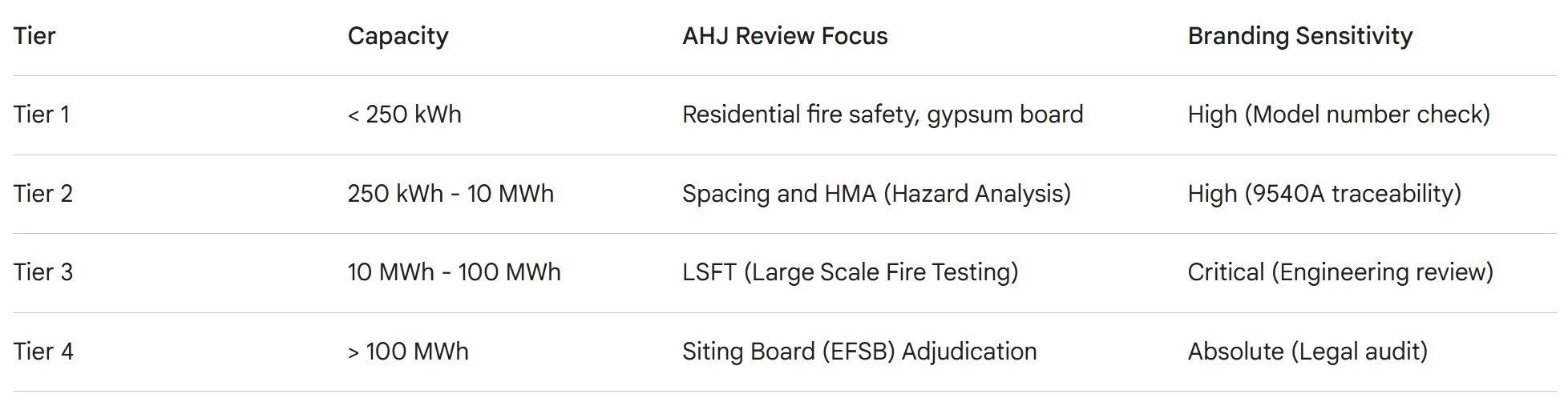
In the United States and Canada, the ultimate authority for project approval is the local AHJ, typically a fire marshal or electrical inspector. These officials rely on the "listed and labeled" principle. If the equipment nameplate does not match the certification provided in the permit application, the installation is technically non-compliant with National Electrical Code (NEC) Article 706 and NFPA 855.
Field Inspection and Label Mismatch
Electrical inspectors perform a direct physical audit of the equipment nameplate. Snippets of technical tender documents reveal that "label mismatch" is a common ground for equipment rejection and rework. In Massachusetts, the 527 CMR 1.00 Fire Code mandates that BESS installations over 20 kWh follow strict permitting paths that include a review of manufacturer-specific documentation.
If a contractor in Massachusetts submits a permit using REPT’s certifications for a system arriving with Star Charge labels, the permit will likely be suspended. The AHJ has the broad authority, under sections such as 527 CMR 1.00: 1.4, to require tests for proof of compliance at the owner's expense if evidence is insufficient.
Massachusetts Model for BESS Permitting
Insurance, Liability, and Financial Exposure
The financial viability of a BESS project is inextricably linked to its insurability and its eligibility for tax incentives. Rebranding without matched certifications creates a "coverage gap" that can be catastrophic for investors.
Insurance Denial of Coverage
Insurers typically require UL 9540 and UL 9540A certification as a prerequisite for underwriting. If a rebranded unit is involved in a fire incident and the subsequent investigation finds that the unit was "unlisted" under its current brand name, the insurer may initiate a "denial of coverage". This is because the operation of uncertified equipment is often a breach of the "safety and maintenance" clauses of commercial insurance policies.
One BESS underwriter noted that fire risk is the dominant concern, and underwriters are increasingly pricing renewals based on "data traceability" to the 6th Edition of UL 9540A. A rebranded product with a legacy OEM report is viewed as a high-risk asset, leading to significantly higher premiums or total lack of coverage.
Investment Tax Credit (ITC) and FEOC Risks
A critical insight for companies like Star Charge involves the federal landscape of the 2024 Climate Act and the Inflation Reduction Act. Star Charge Americas positions itself as a "non-Foreign Entity of Concern (FEOC)" partner, which is essential for developers seeking to maximize Investment Tax Credits (ITC) for grid-scale projects.
However, if the rebranding is perceived as a purely administrative layer over a Chinese-manufactured system (REPT) without significant domestic value-add, the project may face challenges under FEOC definitions. If a federal audit reveals that the underlying technology remains under the control of a Chinese entity, the developer could be forced to repay millions in tax credits. Ensuring that the safety certifications and manufacturing records are fully transferred and managed by the U.S. entity (Star Charge Americas) is a vital defensive step in this geopolitical environment.
Impact of Hardware and Software Modifications
The integrity of a safety listing is tied to the exact Bill of Materials (BOM) and firmware version that was tested in the lab.
The Danger of "Equivalent" Components
During the rebranding process, integrators often seek to optimize the system by replacing peripheral components such as fans, fuses, or contactors with parts from their own supply chain. While these may have similar ratings, they often have different performance characteristics. A fan that moves slightly less air or a fuse with a slower reaction time can completely alter the system's behavior during a thermal runaway event. Introducing unverified parts into a system that passed UL 9540A testing effectively voids the test's applicability, as the configuration in the field has never been validated for fire propagation.
Software-Defined Safety Risks
Modern BESS units like the Star Charge eBox 251 utilize sophisticated control systems to manage charging, discharging, and thermal management. The logic embedded in the Battery Management System (BMS) and Energy Management System (EMS) is a core component of the UL 9540 listing.
If Star Charge makes significant updates to the REPT firmware—for example, to integrate with its proprietary cloud-based IoT platforms for remote diagnostics—it may void the existing safety certifications. Any change to safety-critical software requires a new evaluation under UL 1998 or the functional safety annexes of UL 9540. Failure to do so means the "safety gene" of the system, which REPT spent years developing, has been compromised by the rebranded listee.
Deep-Order Insights: The Ripple Effects of Rebranding Risks
The analysis of the Star Charge/REPT relationship suggests several underlying trends that will define the BESS sector through 2030.
The Shift from Sticker Compliance to Data Continuity
Historically, a UL "sticker" was sufficient for AHJ approval. However, the publication of the 6th Edition of UL 9540A indicates that the industry is moving toward "data continuity". AHJs now expect a Registered Fire Protection Engineer to interpret the specific Heat Release Rate (HRR) and gas composition data from the 9540A report to confirm the safety of the site layout. A rebranded entity that lacks the "engineering-based characterization" data from the original OEM tests will find itself unable to satisfy these increasingly rigorous reviews.
The Professionalization of the BESS Supply Chain
The partnership between Mindra Group and REPT BATTERO for the Indian market, and the JV between Star Charge and Schneider Electric in Europe, demonstrate a trend toward "localization of trust". For Star Charge to lead in the U.S. data center boom, it cannot simply be a distributor of Chinese technology. It must evolve into a "full-stack safety owner". This involves taking direct responsibility for maintaining safety certifications throughout the product life cycle, including management of the "Battery Passport" required by future regulations.
The Emergence of the "Digital Passport"
From 2027, global regulations will likely require every BESS to have a digital identity that tracks its carbon footprint, material origin, and safety history. For a rebranded product, this creates a complex reporting requirement: the passport must identify both the cell manufacturer (REPT) and the system listee (Star Charge). A mismatch in this digital trail will lead to immediate exclusion from high-value government and utility tenders.
Mitigation Strategies for Stakeholders
To navigate the risks identified in this report, participants in the BESS value chain must adopt a proactive approach to certification management.
For Rebranding Companies (e.g., Star Charge)
Star Charge must move beyond simple label changes and institutionalize a "Multiple Listing Management" office. This team should:
Establish Correlation: Ensure every model number in the US catalog is formally listed in the UL Product iQ directory under the Star Charge Americas file.
Maintain BOM Discipline: Strictly forbid any local changes to safety-critical components without prior written approval and technical review by the original REPT engineering team and the NRTL.
Engage AHJs Early: Provide project developers with comprehensive "Submittal Packages" that include the Multiple Listing Correlation Sheet and a "Traceability Memo" linking the rebranded brand to the original REPT 9540A test data.
For Project Developers and EPCs
Due diligence must move deeper than verifying the existence of a certificate. Developers should:
Verify Nameplates: During factory acceptance testing (FAT), confirm that the model numbers on the physical units match the UL listings provided in the bid.
Audit the Listing Directory: Do not rely on paper certificates; check the UL Product iQ or Intertek directory in real-time to ensure the brand name on the equipment is officially recognized.
Review the HMA: Ensure the Registered Fire Protection Engineer performing the Hazard Mitigation Analysis has access to the full REPT 9540A report and has confirmed that the Star Charge-branded unit uses the identical enclosure and venting system that was tested.
For Insurers and Financiers
To protect asset value, financiers should:
Mandate Continuity: Include "Continuous Certification" clauses in project finance agreements, requiring the operator to maintain the safety listing through all software and hardware upgrades.
Verify ITC Compliance: Perform independent legal audits of the rebranding arrangement to ensure it meets the "non-FEOC" standards required by U.S. federal tax law.
Climate Risk Integration: Require that the BESS insurance package includes a review of the 6th Edition UL 9540A data to ensure the project is resilient against extreme weather and fire propagation events.
Synthesis and Nuanced Conclusions
The rebranding of REPT BATTERO technology by Star Charge is a sophisticated commercial strategy that leverages the strengths of the Chinese battery ecosystem to meet U.S. infrastructure demands. However, from a safety and regulatory perspective, the certifications held by REPT are not valid for the Star Charge brand name unless a formal administrative bridge is established.
Key Findings
The original UL 1973, UL 9540, and UL 9540A certifications are valid for the tested product architecture, but they are not valid for the unlisted rebranded model numbers. Without an official Multiple Listing entry in the UL directory, the Star Charge BESS is legally uncertified in the eyes of AHJs and insurers.
Project failure is most likely to occur at the "traceability interface". If an inspector finds a name mismatch or if an insurer identifies an enclosure change that was not part of the original OEM test, the project’s bankability and safety credentials will evaporate.
The "Chain of Safety" requires that the engineering prowess of the manufacturer (REPT) be technically and administratively locked to the brand identity of the listee (Star Charge). For Star Charge Americas, the path to success in its 32.24 GWh program lies in meticulous compliance documentation that leaves no room for administrative ambiguity.
Strategic Outlook
As the industry moves toward 2030, safety will increasingly be defined by "lifecycle traceability". Rebranded products that fail to maintain a transparent and verified link to their technical origins will be phased out by a market that is increasingly intolerant of fire risk and administrative opacity. The professional standard for BESS deployment in North America is no longer just high performance; it is the absolute integrity of the certification chain.
In the final analysis, safety is the lifeline of the energy storage industry. While rebranding technology is a valid way to scale, it must be accompanied by the same level of investment in regulatory science that REPT BATTERO applied to its electrochemical engineering. For Star Charge, the certifications are not "gone"—they are simply "unbridged" until the formal Multiple Listing and private labeling protocols are strictly followed.
Closing Narrative
The interaction between the Star Charge commercial model and the REPT technical foundation is emblematic of the "Second Phase" of the global energy storage market. Phase One was characterized by cell manufacturing dominance. Phase Two is characterized by system-level integration and local regulatory mastery. For Star Charge Americas to fulfill its $3.2 billion contract, it must ensure that its brand name becomes synonymous with the same safety standards that the underlying REPT technology was built to achieve. The validity of the certifications is not a static fact but a dynamic process of administrative maintenance and technical preservation. Stakeholders who understand this distinction will lead the next decade of grid-scale energy storage, while those who rely on "ghost listings" will face insurmountable legal and financial barriers.
Deep-Order Insights on Safety-Critical Components
To further understand the risk, one must examine why a name change and component modification are so heavily regulated.
The Physics of Enclosure-Interdependent Safety
The UL 9540A test for units evaluates the interaction between the battery modules and the enclosure’s ventilation system. During a thermal event, the concentration of flammable gases—such as hydrogen, carbon monoxide, and hydrogen fluoride—must be managed to prevent deflagration. If Star Charge rebrands a REPT system but uses an enclosure from a third-party U.S. supplier to meet "domestic content" rules, the original REPT unit-level 9540A report becomes technically irrelevant. The gas flow dynamics and pressure relief behavior of the new enclosure have not been validated. This represents a "silent risk" where the product is nominally certified at the module level (UL 1973), but has zero valid performance data for its system-level fire behavior.
The Lifecycle of Software Compliance
The 2026 edition of NFPA 855 introduces requirements for "Emergency Response Plans" that are increasingly informed by real-time BMS data. If Star Charge modifies the BMS firmware to enable high-speed data export to a data center's control system, it creates a "versioning gap". The NRTL listed version 'A' but the field is running version 'B'. In a post-fire forensic audit, this discrepancy will be used to transfer liability from the manufacturer to the rebranding listee, who made the unauthorized software changes.
The path forward for Star Charge is clear: rigorous administrative alignment, absolute hardware consistency, and early AHJ engagement to ensure that their ambitious 32.24 GWh pipeline remains a safe and profitable cornerstone of the U.S. energy landscape.
Comprehensive Certification Timeline for Rebranded BESS (Projected 2026)
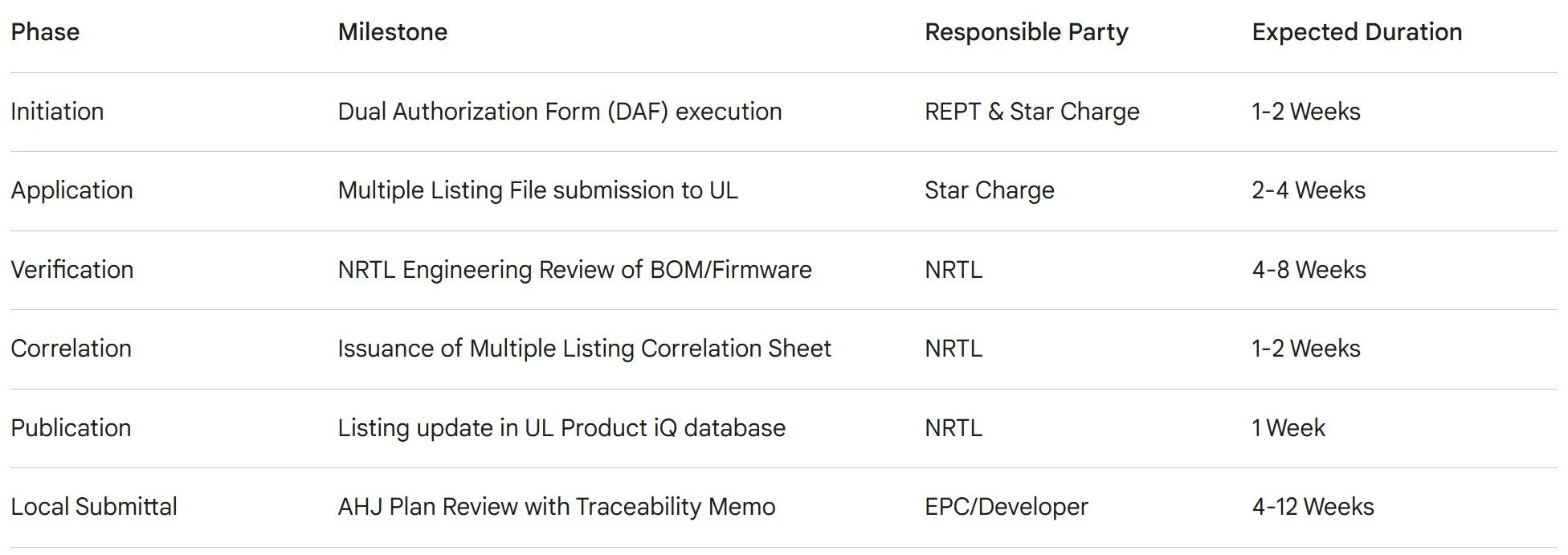
This timeline illustrates that even for an identical product, the administrative transition requires a minimum of 3-6 months to reach a state of full regulatory readiness. Projects that attempt to bypass this timeline and "borrow" the OEM's listing will inevitably encounter friction at the AHJ or insurance checkpoint, leading to costs far exceeding the original investment in proper Multiple Listing.
The evidence consistently points to one conclusion: the REPT certifications are the technical foundation, but the Star Charge listing is the regulatory license. One cannot exist in the market without the other being properly correlated through a recognized authority.
The Evolution of AHJ Sophistication
An underlying trend noted across the snippets is the "Professionalization of the Inspectorate". Fire officials in towns like Beverly and Northborough are no longer just looking at electrical drawings; they are asking for "Hourly fire-resistant-rated assemblies" and "Toxic gas release profiles" derived from UL 9540A reports. If Star Charge provides a report with REPT's name, but the labeling on the batteries says Star Charge, the inspector is trained to view this as a potential "Counterfeit or Unlisted" risk. This skepticism is fueled by the history of fire incidents in the sector and the resulting drive for total transparency.
The rebranding company must therefore act not just as a seller, but as a "Compliance Custodian," ensuring that every document provided to the AHJ creates a perfect mirror of the physical asset being installed. This role is essential for maintaining the "bankability" of the 32.24 GWh program and for securing the long-term trust of the critical infrastructure sector.
Final Evaluation: Are Original Certifications Valid for Rebranded BESS?
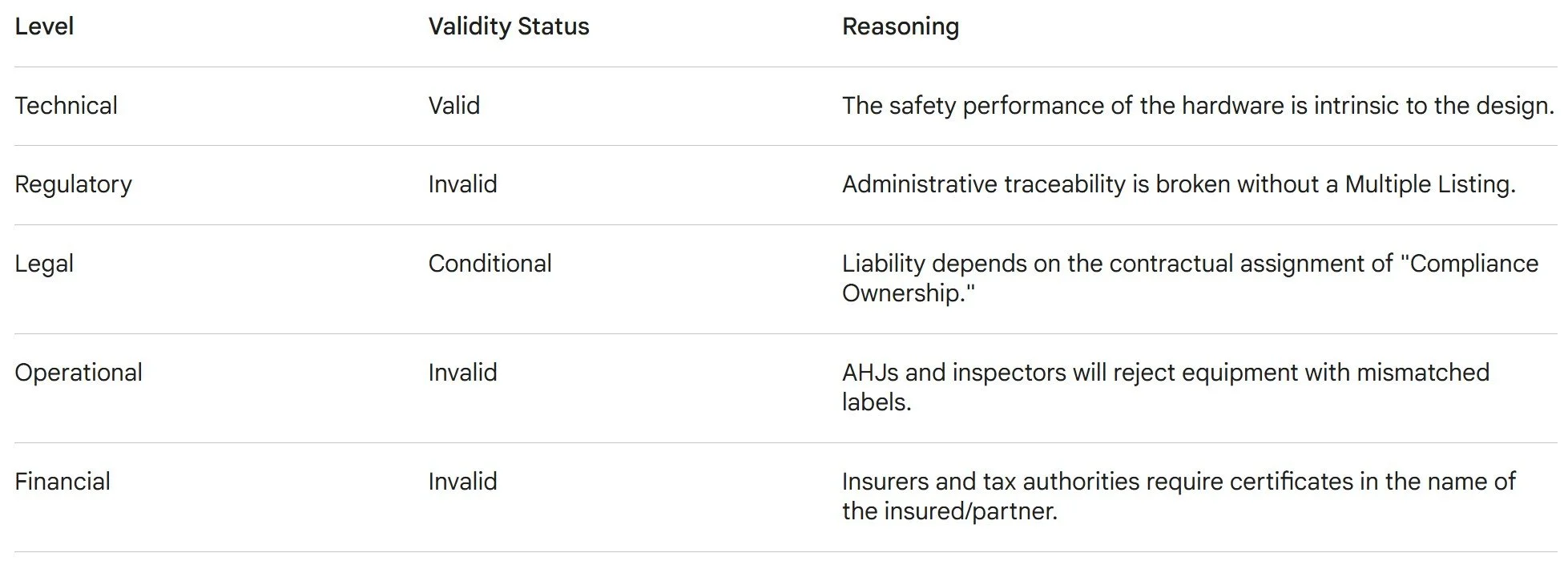
In conclusion, while the physics of the safety remains, the regulatory recognition of that safety vanishes the moment a new nameplate is applied without follow-up from the NRTL. For Star Charge and REPT, the success of their partnership depends on bridging this gap through the rigorous administrative protocols established by UL and other safety bodies.